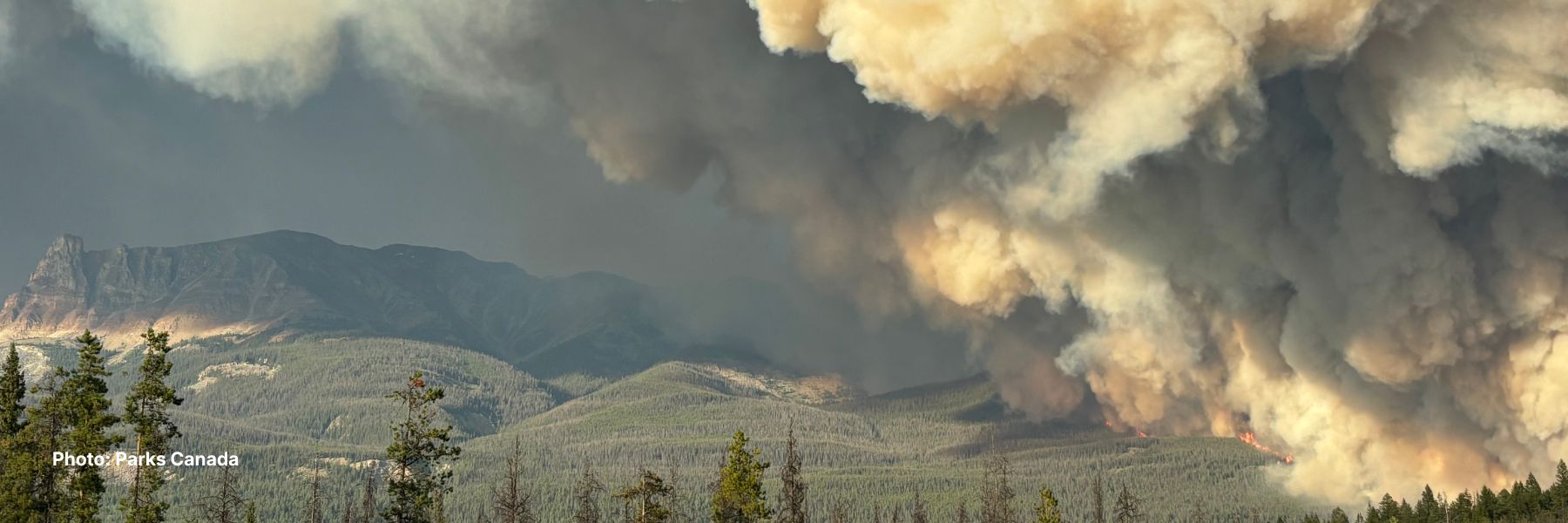
Wildfires do not just destroy trees. They close the trails we ride, the watersheds we paddle, the peaks we climb, and the mountains we ski. They devastate tourism economies, force outdoor businesses to shutter mid-season, and threaten the homes of people in mountain towns and rural communities.
The Policy Details
If you ski, snowboard, trail run, mountain bike, paddle, climb, or spend any time in the wild places that make Canada extraordinary these policy proposals are for you. Protect Our Winters Canada is asking the federal government to take three bold steps that will protect the landscapes we love, strengthen the communities built around outdoor recreation, and give Canada a fighting chance against the climate crisis that threatens all of it.
Here is what we are asking for, why it matters, and what is at stake if we do not act.
1. THE CHALLENGE
In 2023 and again in 2025, Canada hit National Preparedness Level 5, the highest possible, for nearly the entire wildfire season. Every domestic resource was committed. Smoke blanketed cities thousands of kilometres away. Trails, parks, campgrounds, and ski hills closed. Communities evacuated. Entire seasons were lost.
Canada faces over $6 billion in annual wildfire damages and 600 million tonnes of CO2 emissions from fires each year which is a feedback loop that accelerates the very climate change driving more extreme fire seasons. Roughly 3% of fires cause 97% of the damage. The science is clear: investing in early detection and rapid response could reduce losses by 30 to 78%.
2. WHY IT MATTERS FOR OUR COMMUNITY
Wildfires do not just destroy trees. They close the trails we ride, the watersheds we paddle, the peaks we climb, and the mountains we ski. They devastate tourism economies, force outdoor businesses to shutter mid-season, and threaten the homes of people in mountain towns and rural communities. Smoke events now regularly cancel outdoor events and make entire regions inaccessible for weeks at a time.
Indigenous fire guardians, whose traditional knowledge of landscape and fire has been protecting these lands for millennia, are an under-resourced and underleveraged part of the solution. A genuine national strategy must include them as leaders, not afterthoughts.
If we do not invest now, each year of inaction means more emissions, more destroyed habitat, more economic disruption, and a faster-changing climate that makes the problem worse.
3. WHAT WE ARE ASKING FOR
We are calling for a $4.1 billion investment over five years across three pillars:
-
$400M $400 million for surveillance and monitoring: continuous real-time fire detection using drones, high-frequency satellite feeds, and support for Indigenous fire guardians — because the planned WildFireSat satellite (arriving in 2029) only provides twice-daily snapshots, which is not enough for operational response.
-
$2.5B $2.5 billion for suppression capacity: modernizing aerial and ground fleets for provinces, territories, municipalities, and Indigenous governments, with federal investment focused on procurement and interoperability while local authorities retain operational control.
-
$1.2B $1.2 billion for training and equipment: building surge capacity so communities and governments can respond to increasingly extreme, climate-driven fire behaviour.